Latest Digest
Starlink Daily Digest — 2025-12-09
No new Starlink-specific environmental, cybersecurity, or astronomical developments were identified on
2025-12-09 during routine cross-domain monitoring. The constellation’s risk posture for this cycle
appears stable within the limits of currently available public data.
Key Findings
Environmental
Status: No Starlink-specific changes detected.
Recent checks of atmospheric re-entry logs, orbital decay catalogs, and regulatory bulletins showed no newly
confirmed Starlink re-entries, debris notices, or enforcement actions since the prior digest. Within the
constraints of available data, the cumulative alumina load and debris profile remain consistent with previous
cycles, suggesting no short-term deviation from the modeled environmental risk trajectory.
Cybersecurity
Status: No Starlink-specific changes detected.
Reviews of vulnerability disclosures, CERT/CC and national CERT feeds, vendor advisories, and open
threat-intelligence reporting produced no fresh references to Starlink user terminals, ground infrastructure,
or associated supply-chain compromises. The absence of new public advisories this cycle indicates a steady
threat surface rather than evidence of safety, and continued monitoring remains warranted given Starlink’s role
in critical connectivity.
Astronomical
Status: No Starlink-specific changes detected.
Optical streak reports, radio-frequency interference notes, and observatory mitigation updates showed no new
Starlink-attributed survey-contamination events or RFI anomalies since the last check. Existing mitigation
practices and survey workarounds appear unchanged, leaving the overall astronomical impact profile similar to
prior assessments for this short interval.
Summary of Changes
| Domain |
Updates Detected |
| Environmental |
No |
| Cybersecurity |
No |
| Astronomical |
No |
Incident Timeline
-
2025-12-09 — Routine monitoring completed. No Starlink-specific incidents, re-entry confirmations, or regulatory actions were identified across environmental, cybersecurity, or astronomical sources.
-
2025-12-08 — Previous digest also recorded no new Starlink incidents following cross-checks of re-entry notices, cybersecurity advisories, and observatory reporting.
-
2025-04-28 — Dates refer to publication or data-release dates of the cited sources.
-
2022-08-10 — Includes terminal/dish vulnerabilities, network/ground incidents, advisories, and notable policy actions related to Starlink.
-
2022-01-10 — Optical streak contamination, radio-frequency interference, mitigation updates (coatings/visors/orbit), survey impacts, and notable “satellite train” visibility items.
-
Most recent confirmed Starlink re-entry — The latest Starlink re-entry record in the CelesTrak/SATCAT “decayed objects” dataset remains unchanged relative to the prior digest unless otherwise noted above.
Quiet days are logged explicitly to preserve an auditable history of checks, distinguish true low-activity periods
from monitoring gaps, and support future trend analysis.
Methodology & Rationale
Why These Domains Are Tracked
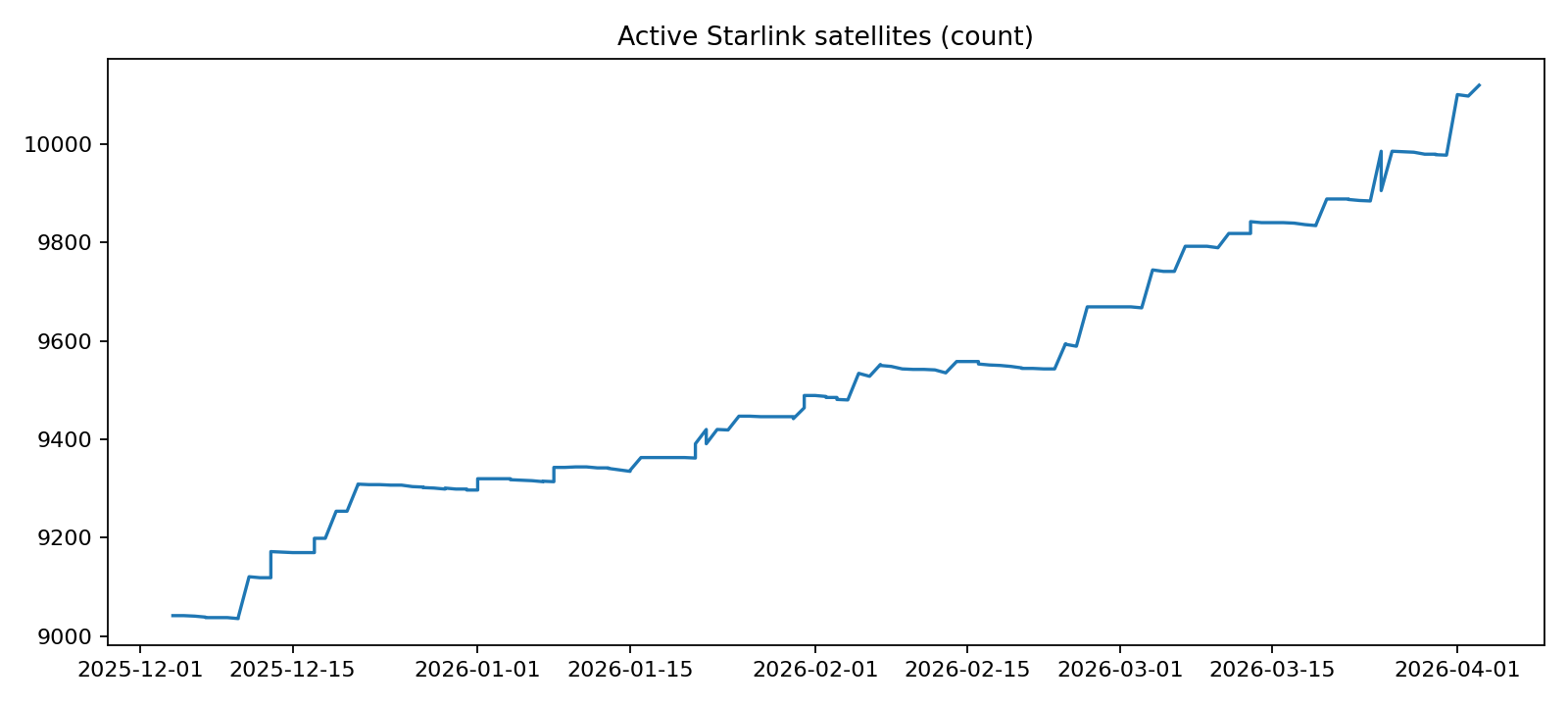
This project tracks three classes of risk where a constellation as large as Starlink can generate outsized
systemic effects:
- Environmental — Atmospheric re-entries, alumina production, debris generation, and any regulatory or scientific findings relating to climate and ozone impacts.
- Cybersecurity — Vulnerabilities, exploitation, and operational security issues involving user terminals, ground infrastructure, or Starlink’s role in high-value networks.
- Astronomical — Optical streaks, survey contamination, radio interference, and mitigation measures affecting professional observatories and large survey projects.
The goal is not to predict every outcome but to maintain a disciplined, source-driven record of developments that
could materially change the constellation’s risk profile over time.
Environmental Modeling
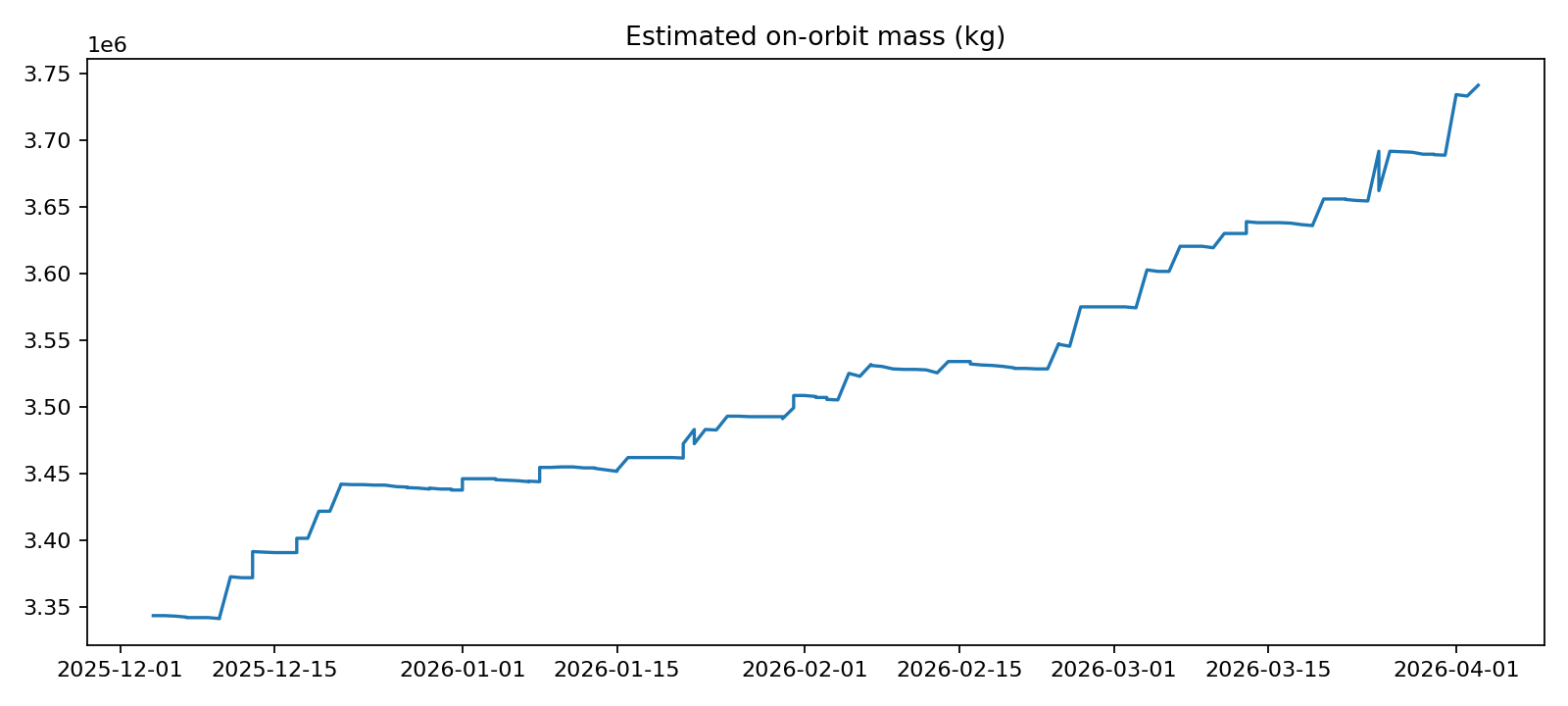
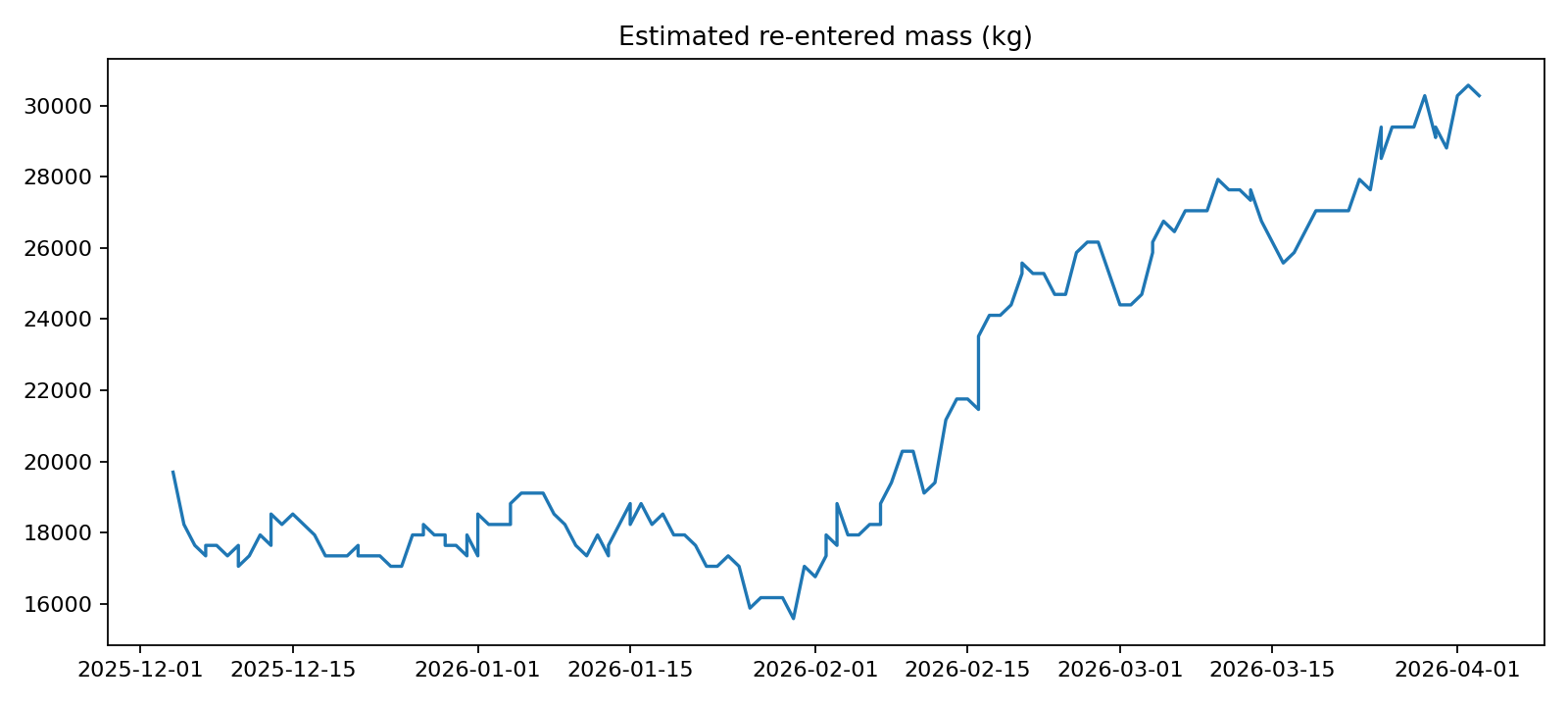
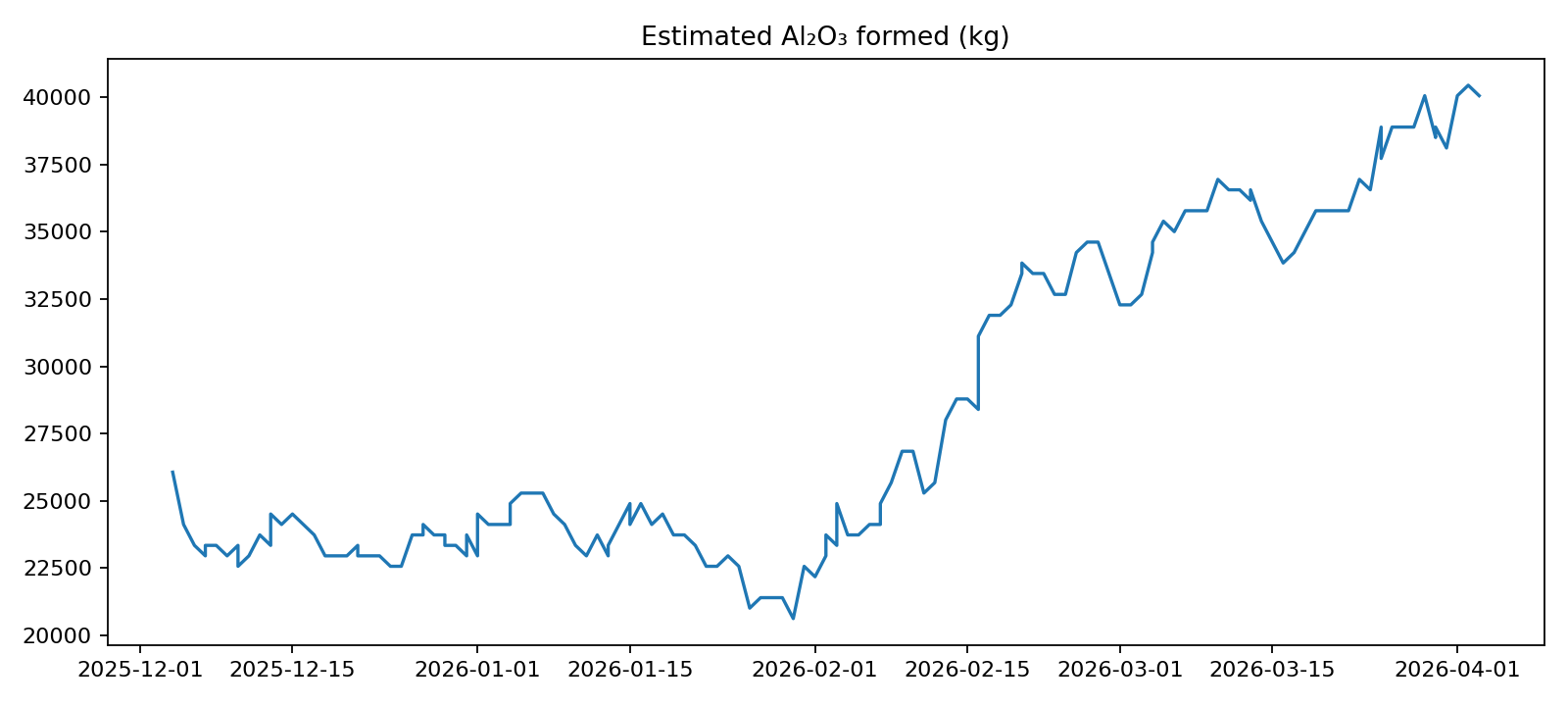
Environmental assessments combine object counts, re-entry events, and simple alumina mass estimates:
-
Object and decay tracking rely on CelesTrak Starlink GP/CSV files for active elements and SATCAT
“recently decayed” lists for confirmed re-entries.
-
Alumina estimates use a generation mass mix defined in
data/starlink_config.yml, encoding assumptions about per-satellite mass, aluminum content, and the
fraction converted to alumina during re-entry. These assumptions are drawn from published re-entry and
spacecraft-material studies and are intentionally conservative.
-
Cumulative impact is tracked as a running total of estimated alumina injected into the upper
atmosphere by confirmed Starlink re-entries, to make the approximate scale and growth of material deposition
explicit rather than abstract.
This matters because alumina can alter radiative forcing and interact with ozone chemistry. Even with wide error
bars, documenting the plausible mass and slope over time is more informative than relying on one-off marketing
claims or isolated estimates.
Cybersecurity Monitoring
Cyber assessments focus on how Starlink terminals and infrastructure appear in public security reporting:
-
Primary inputs include CERT/CC and national CERT advisories, major vendor bulletins, and
reputable threat-intelligence publications.
-
Scope is limited to issues that explicitly reference Starlink hardware, firmware, or
infrastructure, plus clearly linked supply-chain or satellite-control vulnerabilities.
-
Interpretation emphasizes trend and posture: new advisories are treated as signals of an exposed
or actively targeted attack surface; quiet periods constrain what can be concluded from public data.
Because Starlink is being woven into critical communications, battlefield connectivity, and research networks, even
incremental vulnerability disclosures are treated as important signals rather than routine patch notes.
Astronomical Impact Assessment
Astronomical impact monitoring tracks how Starlink appears in the literature and reporting on sky surveys:
- Optical effects — satellite streaks in wide-field survey images, changes in streak frequency, and mitigation tactics such as avoidance windows or exposure adjustments.
- Radio-frequency interference (RFI) — observatory notes and survey documentation describing interference from satellite constellations in relevant bands.
- Mitigation updates — darker coatings, attitude changes, or coordination protocols that alter expected long-term impact.
Survey science depends on clean, statistically stable skies. A constellation that injects structured noise into
those datasets changes both the cost and feasibility of key astronomical programs.
Why “Quiet” Days Are Still Logged
Each digest date is recorded even when no new Starlink-specific developments are found because:
- It provides a continuous audit trail of which sources were checked and when.
- It distinguishes genuine low-activity periods from monitoring gaps.
- It allows future researchers to correlate bursts of activity with documented baselines.
A “no change” entry is therefore treated as a real data point rather than an empty placeholder.
Data Sources
This digest draws from the following public datasets and model assumptions:
-
CelesTrak Starlink GP/CSV — Active Starlink elements, orbital parameters, and counts used to understand constellation scale and decay eligibility.
-
CelesTrak SATCAT – Recently Decayed — Confirmed decay events, including Starlink entries, used to timestamp and tally re-entries.
-
Vulnerability and advisory feeds (CERT/CC, national CERTs, vendor bulletins) — Publicly disclosed vulnerabilities or incidents referencing Starlink user terminals or supporting infrastructure.
-
Astronomical reports and RFI notes — Observatory mitigation reports, optical streak surveys, and radio-interference summaries that mention Starlink or similar constellations.
-
Generation mass mix and alumina assumptions — Parameters defined in data/starlink_config.yml for satellite mass, aluminum fraction, and alumina conversion used in environmental calculations.
All assumptions and mass-mix parameters remain editable in data/starlink_config.yml, and charts on
this site are derived directly from these datasets and configuration values on each run.
Environmental — Archive
Dates refer to publication or data-release dates of the cited sources.
Cybersecurity — Archive
Includes terminal/dish vulnerabilities, network/ground incidents, advisories, and notable policy actions related to Starlink.
Astronomical — Archive
Optical streak contamination, radio‑frequency interference, mitigation updates (coatings/visors/orbit), survey impacts, and notable “satellite train” visibility items.